
Visual Basic 6 replacement: what options really exist and how to migrate without stopping the business
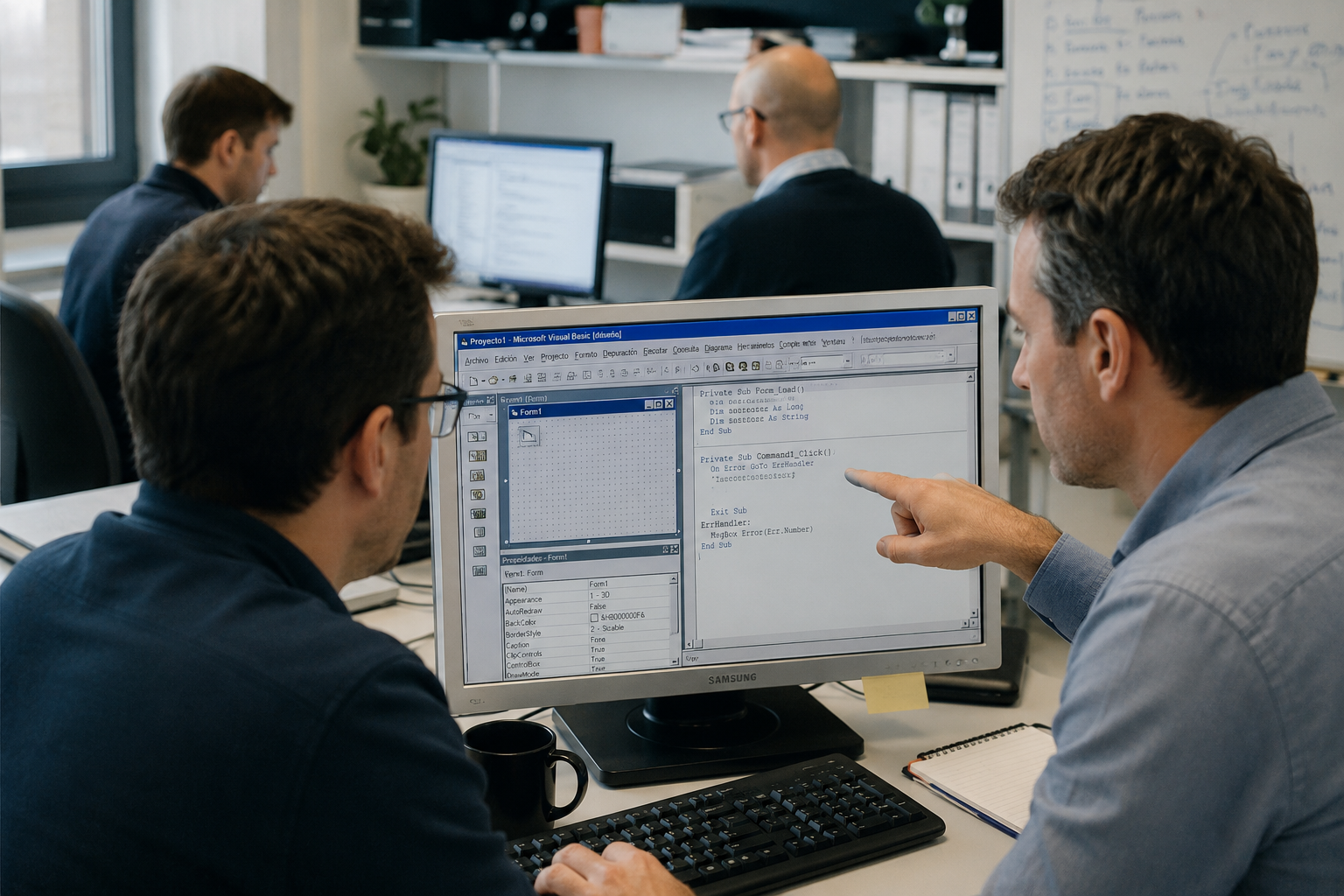
If you have production applications written in Visual Basic 6, you already know that Microsoft ended support in 2008. We have spent eighteen years operating on an environment without security patches, without runtime updates, and without native compatibility with modern 64-bit operating systems. The question of what software can replace Visual Basic 6 is not academic: it is a decision that most CTOs and IT Directors have had pending for years and that, at some point, stops being postponable. This article does not aim to convince you of anything you do not already know. It aims to be the technical guide you were missing to make that decision with sound judgment.
Why you have been postponing the decision for years and what has changed in 2026
The most honest answer is that postponing made economic sense. As long as the system kept working, the cost of not migrating was invisible. The visible costs — migration, operational risk, learning curve — weighed more heavily on the annual budget.
What has changed in the last three years is that this equation no longer works:
Maintenance costs have grown non-linearly. Fewer than 2% of active developers work with Visual Basic as their primary technology (Stack Overflow Developer Survey 2024). The hourly cost of a senior VB6 specialist in Spain has multiplied by 2.3 over the last five years.
Technical debt has reached an inflection point. Applications developed in VB6 between 1995 and 2005 now carry between 20 and 30 years of patches, workarounds, and business logic buried in modules that no one remembers the purpose of.
Regulators are not indifferent. DORA (Digital Operational Resilience Act), in force since January 2025, establishes operational resilience requirements. An unsupported vendor application processing financial transactions is a documented point of regulatory risk.
Real options as a replacement for Visual Basic 6
There are four paths typically considered in any VB6 modernization project:
1. Manual rewrite in a modern language (Java, C#, Python)
It makes sense when the system is small and well documented. 74% of manual rewrite initiatives exceed the initial budget, and 52% do not complete the functional migration within the expected timeframe, according to a 2023 Gartner report. The underlying problem: the business logic lies in years of patches that no one documented.
2. Rewrite assisted by generative AI (GitHub Copilot, LLM models)
Generative AI is not deterministic: given the same input, it can produce different outputs. For banking settlement systems or insurance policy calculation, an unexpected variation is a regulatory risk, not a bug. According to a 2024 Forrester Research report, 68% of AI migration pilots in critical systems were halted بسبب traceability problems.
3. Emulation and encapsulation (wrappers, APIs over the existing system)
A transitional solution, not a modernization one. Useful for gaining 12–18 months while preparing the real migration. The risk: adopting it as a permanent solution and accumulating an additional layer of technical debt.
4. Automatic migration with an industrialized and deterministic process
Our automated migration process, built around our own pivot language, produces verifiable and traceable functional equivalence by following formal rules — not statistical ones. Result: clean, readable code that can be maintained by the in-house team, with no additional licensing. Recommended for systems with 50+ functional units, complex or poorly documented logic, and regulated environments where traceability is mandatory.
Is generative AI already good enough?
For secondary applications: possibly yes. For core applications with 25 years of accumulated rules: no, and probably not within the next three years for that level of criticality.
The argument is not that AI is bad technology — it is excellent for assessment, automatic documentation, and test generation. The argument is that the place where variation is not tolerable is exactly where AI has its inherent limitations. For those systems, determinism is not a marketing argument: it is a functional requirement.
What happens in practice: the decision pattern we have seen in banking and insurance
In the projects we have executed, the process follows this pattern:
-
The initial trigger is almost always an incident, an audit, or a regulatory change. The item has usually remained in the backlog for 2 to 5 years.
-
The first evaluation includes large consulting firms and AI tools. The result: an expensive manual rewrite or an AI pilot that does not scale to critical modules.
-
The final selection criterion is not price. It is technical certainty: “Can I commit this project to my board of directors with a guarantee that it will work?”
A free proof of concept on the system’s own modules answers that question better than any presentation.
Evaluation checklist: before deciding which replacement to use for your VB6 system
- How many windows, modules, or functional units does the system have? (From 100 onward, manual rewriting starts to become unfeasible within reasonable timeframes.)
- Is the business logic documented? (If the answer is “more or less,” there is hidden logic that a manual rewrite will not capture.)
- Does the system process critical transactions or regulated data? (If yes, traceability is a non-negotiable requirement.)
- Can the business tolerate a code freeze during the project? (Most cannot: the business continues evolving while the migration is underway.)
- Can the provider demonstrate verifiable functional equivalence before committing to the full project?
Frequently asked questions about migration and replacement of Visual Basic 6
What is the best replacement for Visual Basic 6 in critical enterprise applications?
There is no direct replacement in the sense of “I install X and the code works the same.” What exists are migration strategies toward modern languages such as Java, C#, or Angular. The most important criterion is not the target language but the migration process: it must guarantee complete functional equivalence, traceability, and must not require freezing the code during the project.
Can generative AI (ChatGPT, GitHub Copilot) migrate VB6 applications?
It can generate code in modern languages from VB6, but not deterministically. For systems that process financial transactions or policy calculations, the lack of verifiable traceability is a problem that no manual review can fully solve at scale. Projects that have tried usually reach 60–70% coverage and get blocked on the most critical modules.
How long does it take to migrate a VB6 system to Java or Angular?
A proof of concept on real modules: 2–4 weeks. A full automated migration project: between 3 and 18 months depending on volume and complexity. The critical variable is not the volume of code, but the complexity of the business logic and whether the business can continue evolving during the migration.
What happens if we continue maintaining VB6 applications in production without migrating?
In the short term, the system will keep working. The risk is cumulative: incompatibilities with modern Windows 11/Server environments, inability to apply security patches, and scarcity of VB6 developers. In the context of DORA (in force since January 2025), operating critical applications without vendor support must be documented as a managed risk.
What is the difference between deterministic automatic migration and manual VB6 rewriting?
Manual rewriting depends on how much the team understood of the original logic. Deterministic automatic migration starts from formal transformation rules: the code is converted through a reproducible process where functional equivalence is verifiable and traceable. Any auditor can see which line of the original code corresponds to which line of the new one.
How do I know if my VB6 system is a candidate for automatic migration?
The best candidates are systems with 50+ functional units, consolidated business logic, regulated environments where traceability is mandatory, and organizations that cannot tolerate system downtime. A free proof of concept on the most representative modules is the fastest way to validate before committing any budget.