
Guillermo Rodríguez | CTO
Nov 10, 2026, 2:11:25 AM
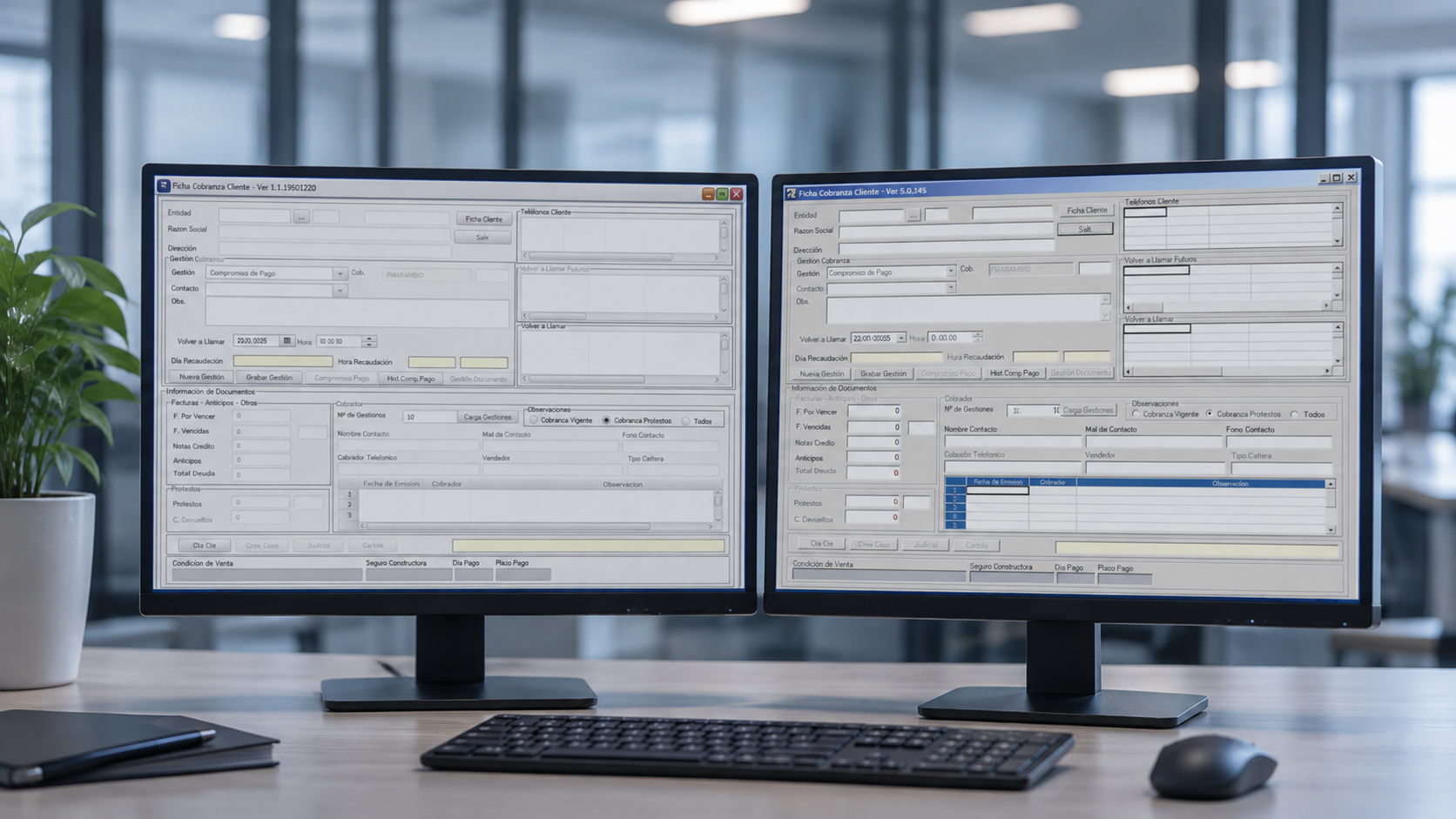
Businesses accumulate years of development, adaptations and features within their applications, many of which are essential to their operations. However, many of these applications were built on technologies that now limit their maintainability, integration capabilities and potential for growth.
At Go4IT Solutions, we modernize legacy applications using a deterministic methodology and our own proprietary tool, capable of analyzing, interpreting and transforming the structures, relationships and dependencies of applications built on different source architectures.
This allows us to undertake modernization projects regardless of the technology on which the original application was developed, preserving its business logic while adapting it to the target technology environment.
In this article, we explain how this approach works and how we applied it to the modernization project for Imperial, a company in the retail sector whose corporate ERP manages key production, sales, inventory, logistics and order management processes.
Not all legacy applications are built in the same way. Some use widely recognized technologies, while others incorporate proprietary architectures, custom components and development conventions specific to each organization.
Over time, these specific characteristics become an essential part of how the system operates.
That is why application migration is not simply a matter of translating code from one programming language to another. It is necessary to understand how components relate to one another, what dependencies exist between them, and what business logic determines their behavior.
Some of the main challenges include:
Addressing these challenges requires a methodology that does not rely exclusively on manual development or individual interpretations.
At Go4IT Solutions, we have developed a modernization tool capable of analyzing and transforming legacy applications, regardless of the specific characteristics of their source architecture.
To achieve this, it uses a Pivot Language, generated during the compilation process. This is a complete language that incorporates the fundamental features of programming languages, such as variables, functions, data models and user interfaces.
This intermediate representation makes it possible to understand each application's structure and behavior and transfer them to the target technology, even when the original system uses proprietary frameworks or components.
An example of our methodology is the project carried out for Imperial, a retail company whose corporate ERP manages key production, sales, inventory, logistics and order management processes.
The objective was to migrate an application built on a proprietary VB6 component-based architecture (ADAPI) to the Java evolution of that same architecture (JADAPI), while preserving its business logic and ensuring operational continuity.
The ERP was built on a proprietary component-based framework, some of whose components had no direct equivalent in JavaFX. These included advanced spreadsheet-like controls (FPSpread), which were essential for inventory and logistics teams.
The challenge was to understand their functionality and dependencies in order to recreate them using the new technology while preserving their original behavior.
Using our modernization tool, we analyzed and transformed nearly 1,000 screens and functional components, adapting the structures and dependencies of the original architecture to the Java environment.
The most complex components were reimplemented in JavaFX, preserving their capabilities and existing business logic.
The project enabled Imperial's ERP to evolve towards a JavaFX-based architecture. Key results included:
Yes. Each architecture requires an analysis and transformation rules tailored to its specific characteristics. Our tool is designed to understand different technology structures and their dependencies, making it possible to tackle projects involving heterogeneous architectures and proprietary components.
It is necessary to identify how they work, how they relate to other elements and what capabilities they provide. Based on this analysis, the necessary equivalents are defined to transfer their behavior to the target technology environment.
It means that the transformation follows predefined rules and produces consistent, reproducible results when the same input conditions and configuration are maintained. This provides greater control and predictability throughout the process.
Yes. A fundamental part of the process involves identifying and preserving existing business logic. The goal is to evolve the technology without altering the processes that are essential to the organization.